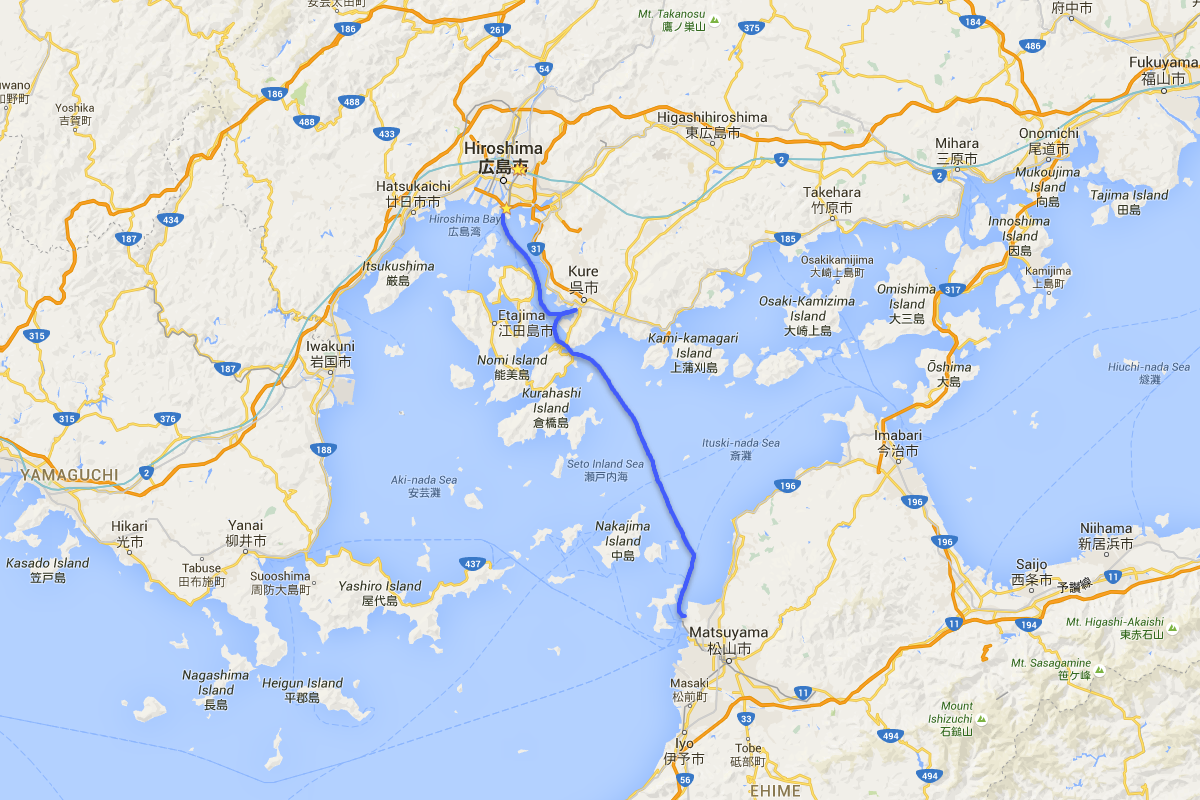
Vandaag lieten we Hiroshima achter ons. Letterlijk, want we namen de high-speed boot naar Matsuyama. Eénmaal op de boot ging het inderdaad snel, de tocht naar de haven was tergend langzaam verlopen. Er loopt een tramlijn naar de haven, maar die tram stopt aan elk rood licht, en die blijken zeer kwistig rondgestrooid te zijn in Hiroshima. Het blijft ook telkens erg lang rood, zodat we uiteindelijk bijna een uur deden over 7 km.
Ook nu weer bleek dat ze in Japan erg houden van cash geld. De oversteek kostte 3800 yen per persoon (zo’n 31 euro) maar dat konden we niet met de kaart betalen. “Cash only” kregen we te horen. Vervelend, niet alleen omdat het niet zo fijn is om met veel cash rond te lopen, het is ook niet zo makkelijk geld af te halen: om te beginnen zijn er niet zoveel ATMs die internationale kaarten aanvaarden, en zelfs al staat er een Maestro-logo op de bankautomaat, vaak wordt de kaart dan toch nog geweigerd.
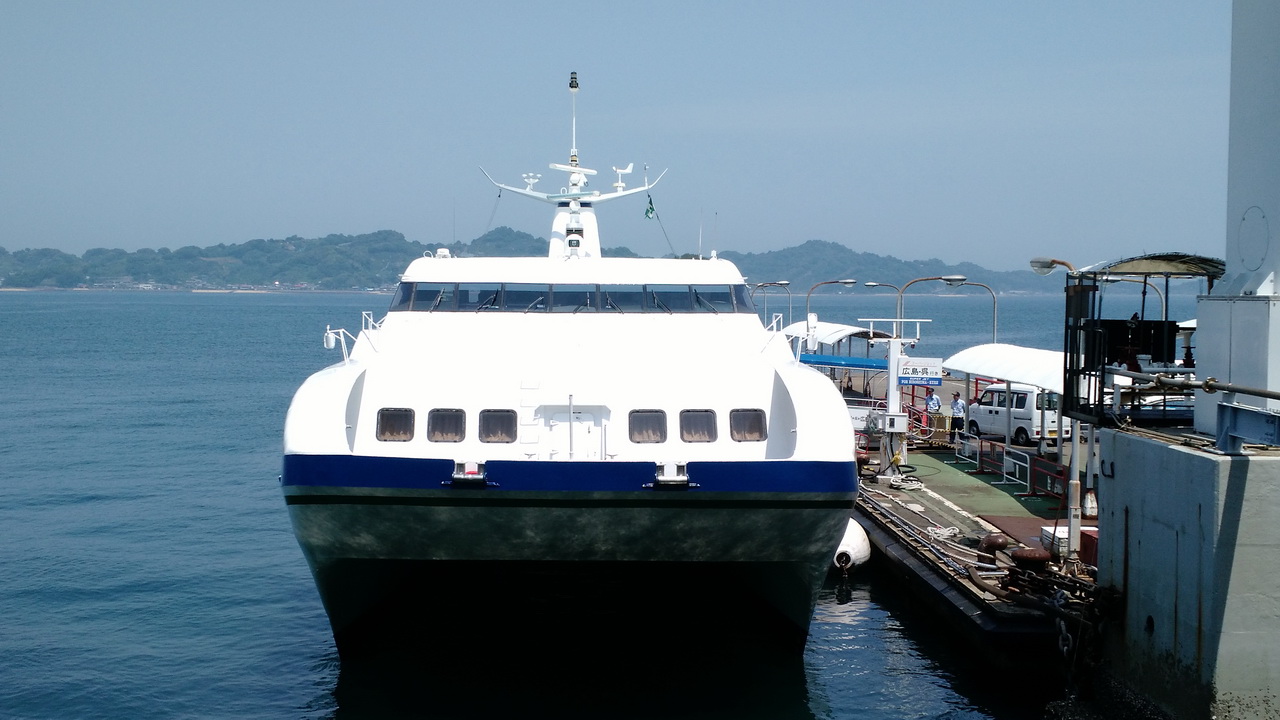
De overzet verliep vlekkeloos: een dik uur later gingen we aan land in de Shikoku regio, in vogelvlucht zo’n 75 km van Hiroshima (dat op Honhsu ligt).
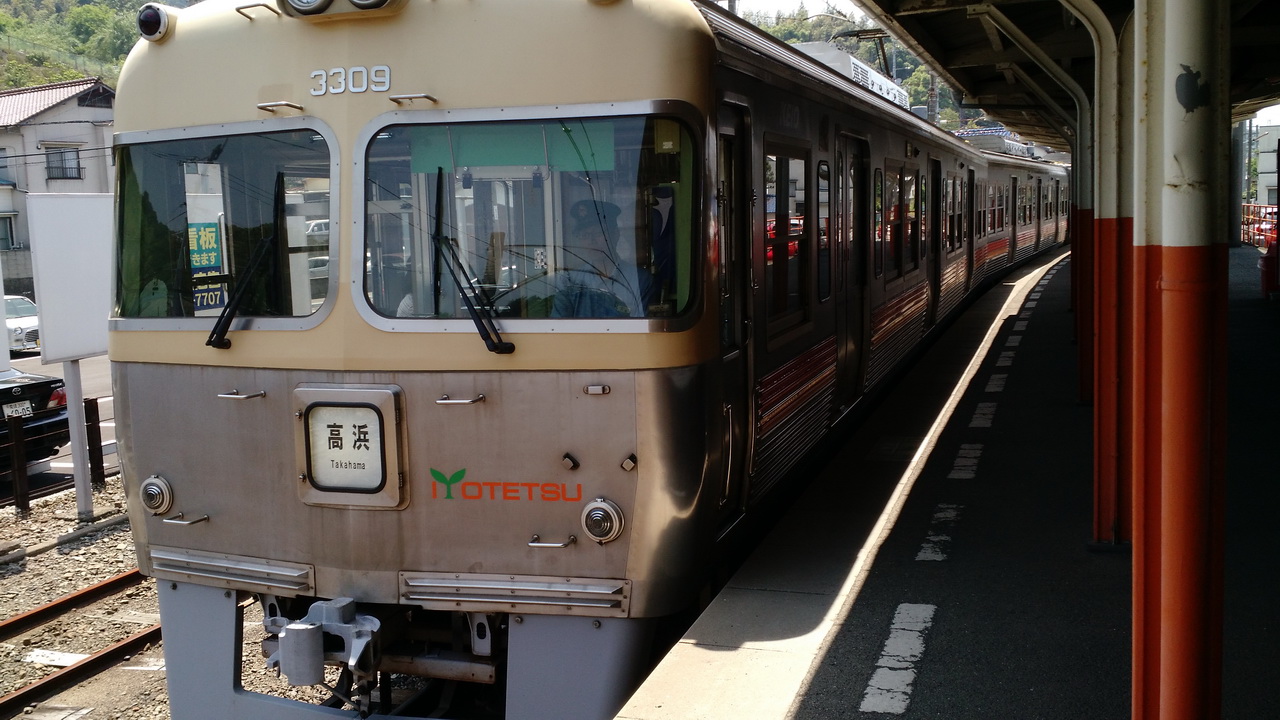
Na een pendelbus, een treinrit en een alweer tergend trage tramrit, kwamen we aan bij Dogo Onsen.
Vooraleer we dit bekende badhuis bezochten, hadden we eerst lunch bij おいでん家 (Oidenda – www.oidenka.jp) waar we konden bestellen met een iPad. Op zich handig, omdat je foto’s ziet van wat je kan bestellen. Maar één van de lunchopties was “with Onsen ticket”. Het was echter onduidelijk of dat een speciale prijs was als je al een ticket van het badhuis had, dan wel of het een lunch mét een ticket voor het badhuis was. En als het om de laatste optie ging, wat er dan precies in dat ticket begrepen zat, want er waren verschillende tarieven in Dogo Onsen. Het blijft op zo’n moment erg frustrerend om vast te stellen dat je na ruim een half jaar Japanse les niet eens relatief eenvoudige vragen als “is dit als je al een ticket hebt of krijg je hier een ticket bij?” en “wat krijg je dan in de Onsen voor dat ticket?” kan stellen.
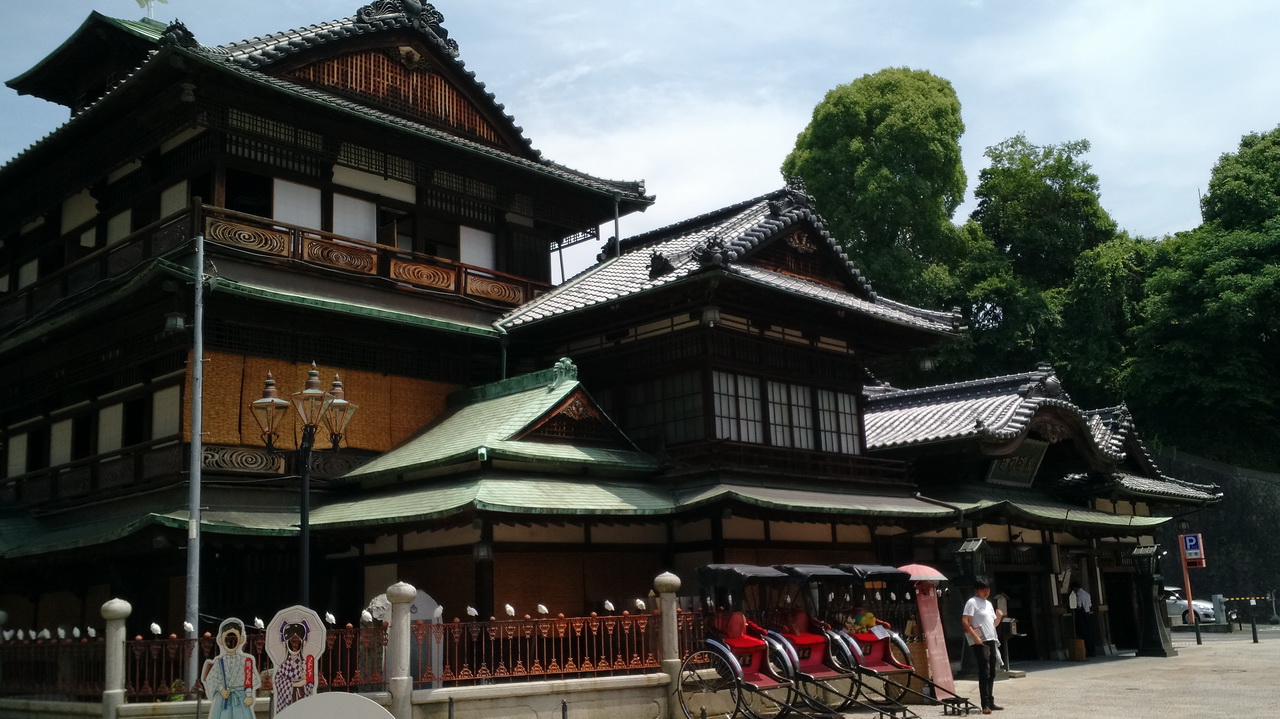
Uiteindelijk bleek het dus een ticket te zijn waarmee je niet alleen het bad binnen mocht, maar je daarna ook in de lounge, enkel in een lichte kimono, van een thee en koekjes kon genieten. Nice! (Mijn GSM lag beneden in een locker, dus geen foto’s hiervan bij deze post – Philippe heeft er wel genomen met zijn deftig fototoestel, die komen dus nog wel eens online als we terug thuis zijn)
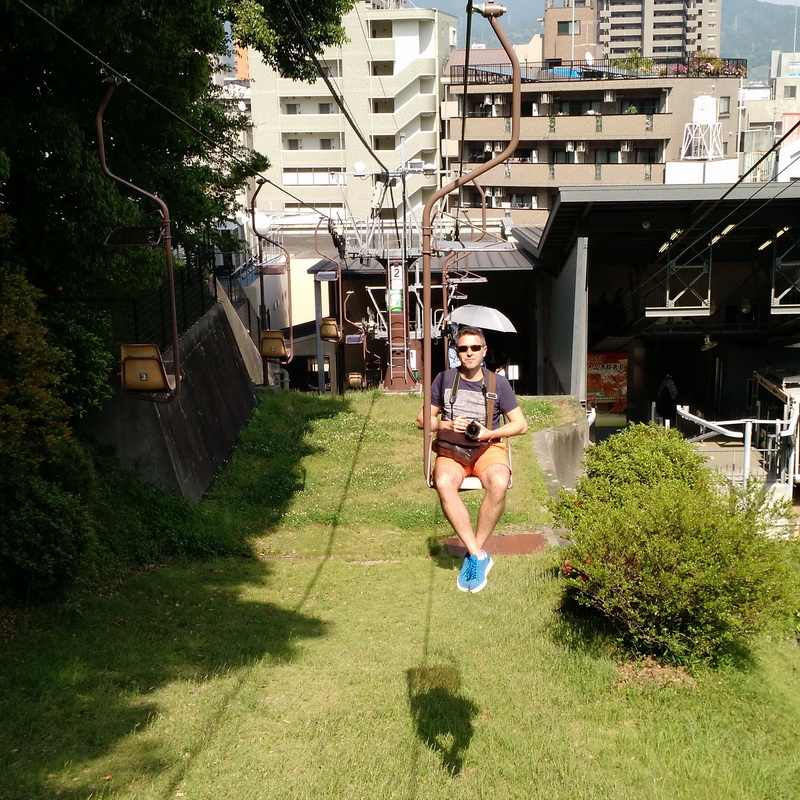
Dan trokken we naar Matsuyama Castle. Dat ligt op zo’n 130m hoogte, het eerste gedeelte van de klim kan je met een kabellift doen. Heel wat dingen in Japan doen aan Amerika denken, maar dit was duidelijk daar geen voorbeeld van: ik kan me niet voorstellen dat in de US je zomaar, zonder enige vorm van beveiliging, bv. een ketting of riem, zodat je er niet uit kan vallen, een stoeltjeslift mag nemen.
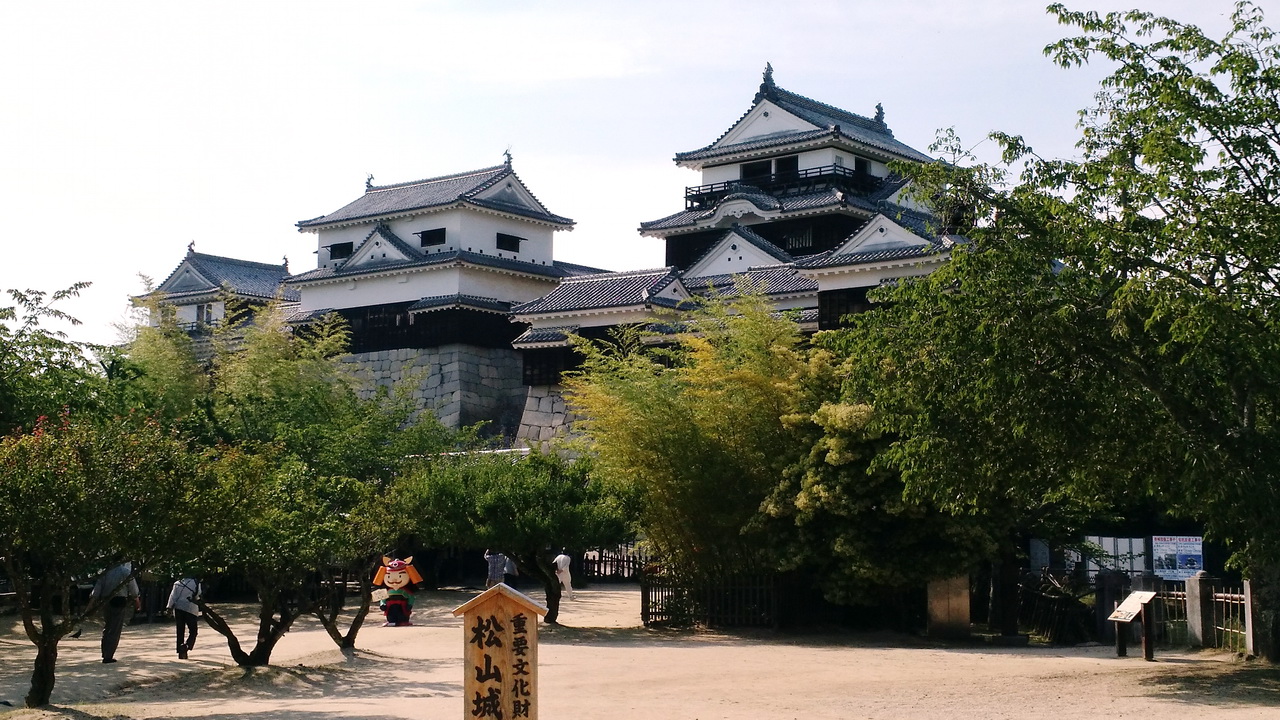
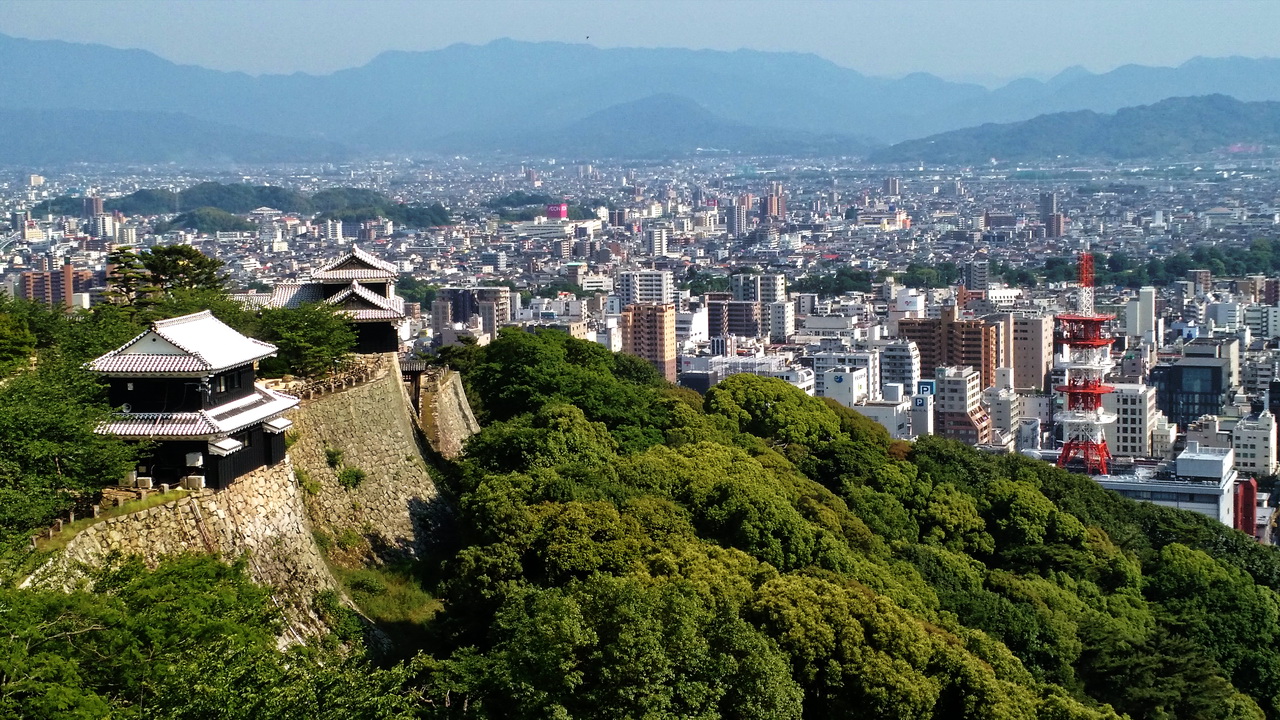
Mastuyama Castle torent hoog boven de stad uit. De uitzichten zijn dan ook de moeite.
Vanavond verlaten we Matsuyama alweer, en nemen de trein naar Kotohira, zo’n 170 km naar het westen.
Meer info
[learn_more caption=”Kaart Matsuyama”] [button link=”http://blog.krisphilippe.be/wp-content/uploads/2016/05/Matsuyama.pdf” type=”icon” icon=”paper”] Kaart Matsuyama (pdf)[/button] [/learn_more] [learn_more caption=”Highspeed boot Hiroshima > Matsuyama”] [/learn_more] [learn_more caption=”Dogo Onsen”]The atmosphere in this small onsen is relaxed; people using the spa wander around the hotels and souvenir shops in yukata (cotton kimonos). Dogo Onsen is one of the oldest in Japan. Its alkaline springs (42°C) are even mentioned in the Nihon Shoki (Japanese Chronicles, 720) and have been visited by many Emperors and eminent historical figures. The baths also feature in writer Natsume Soseki’s novel Botchan (1906), set in Matsuyama and read by nearly all Japanese schoolchildren. Virtually everything at the onsen is still as it is described in this largely autobiographical work, beginning with the small steam train imported from Germany in 1887: the Botchan Ressha. It has only recently been put back into service and renamed in his honor.
Arriving at the square where the tram station is located—also now restored—visitors are greeted by a large clock, Botchan Karakuri, erected in 1994. Small mechanical figures enact scenes from the novel at each quarter hour, accompanied by music. Close by is a foot bath (ashiyu), where tired feet can be soothed in its thermal waters. A shop-lined arcade leads to the baths.
Dogo Onsen Honkan – Constructed in 1894, this large and rather surreal wooden building looks like a cross between a Japanese castle and a seaside villa, with its mix of pagoda-style roofs, colonnades, balconies, paper lanterns, glass windows, and paper partitions. At the top is a turret bearing the figure of a white heron, recalling the onsen’s mythical origin. The building served as the bathhouse in the film Spirited Away by the Japanese director Miyazaki Hayao. At the reception desk you can obtain a leaflet in English listing the prices and how to use the onsen.
Decorated with beautiful mosaics, there are two baths (single sex) and four rates: the Kami-no-yu (“Bath of the Gods”) is the cheapest and most popular, with a communal changing room (|bath ¥400, bath and light meal of tea and rice crackers ¥800). The Tama-no-yu (“Bath of the Spirits”) is a little more intimate (bath ¥1,200, bath and light meal served in a private room on the 3rd floor, ¥1,500). The second floor of the building houses a display of objects linked to the baths or to the Tea Ceremony, and some ancient examples of calligraphy. You could also take the guided tour of the Yushinden (¥250), baths reserved for the Imperial Family that were still in use until 1950. On the third floor is a room dedicated to Natsume Soseki. Finally, in a modern annex 1min walk away from the shopping arcade is the Tsubaki-no-yu, “the Camellia Bath,” which is very popular with local retired people (>open 6am–11pm; |¥360). It is worth noting that most of the ryokan in Dogo Onsen have their own baths.
[/learn_more] [learn_more caption=”Matsuyama Castle”]Matsuyama is proud of being the capital of the haiku a short, yet meaningful poem consisting of 17 syllables. Born in the town, the poet Masaoka Shiki (1867–1902) revitalized and modernized this traditional form of poetry, of which Basho (1644–1694) is acknowledged as the great master. The lively main town of Shikoku, Matsuyama, has grown up around a superb castle perched on the top of a hill. Situated at the center of the great Temple Pilgrimage route, the town itself boasts seven temples, including the eminent Ishite-ji. But the main local attraction has to be a visit to the delightful baths at Dogo Onsen, one of the oldest thermal spas in Japan, which, apart from steam, also exudes a delightful old-fashioned atmosphere.
The castle at Matsuyama is undoubtedly among the finest in Japan because of its impressive position on the slope of a hill at a height of 433ft/132m, with spectacular views * overlooking the town and the Inland Sea. The warlord Kato Yoshiaki began construction of the castle in 1602. Twenty-six years later, a five-story fortress and other palatial buildings, enclosed by walls had been built halfway up the hill. Below the castle lay the fortified town, surrounded by moats; the western part was inhabited by samurai and the eastern part by craftsmen and tradesmen; the temples were situated to the north. Since then, like many castles Matsuyama-jo has undergone various reconstructions.
The main keep, destroyed by lightning in 1784, was restored as a three-story building in 1854. Further work was also carried out in 1968 and 1986 in order to restore it to its original style, employing only techniques and materials used in its original construction (no nails or concrete). Having passed through the Tonashi-mon, you emerge onto a wide plateau planted with cherry trees. Inside the keep is a large collection of sabers, armor, ancient documents, objets d’art, painted panels, and pieces of calligraphy that belonged to the feudal lords Kato, Gamo, and Matsudaira.
[/learn_more]